The impact of AI on government planning, transport and infrastructure
Making Better Decisions for Organisational Success
Artificial intelligence could fundamentally change how governments plan cities, manage traffic, develop infrastructure and deliver public services.
For developing countries, the potential impact is particularly significant. AI offers an opportunity to address infrastructure problems faster, improve the use of limited public funds, reduce traffic congestion and make urban planning more evidence-based.
However, there is an important distinction: AI will not simply automate existing government departments. It could change how those departments think, plan, make decisions, allocate resources and monitor development.
I would look at this transformation across five areas:
- Government planning and policy development.
- Traffic and transport management.
- Town and urban infrastructure planning.
- Infrastructure investment and project management.
- Institutional capacity and governance.
Let’s examine what this means, particularly for developing countries.
1. AI will transform government planning departments
Traditionally, government planning departments rely on:
- Population census information.
- Land-use surveys.
- Development applications.
- Traffic studies.
- Infrastructure assessments.
- Consultants’ reports.
- Historical statistics and projections.
These processes are often slow, expensive and fragmented.
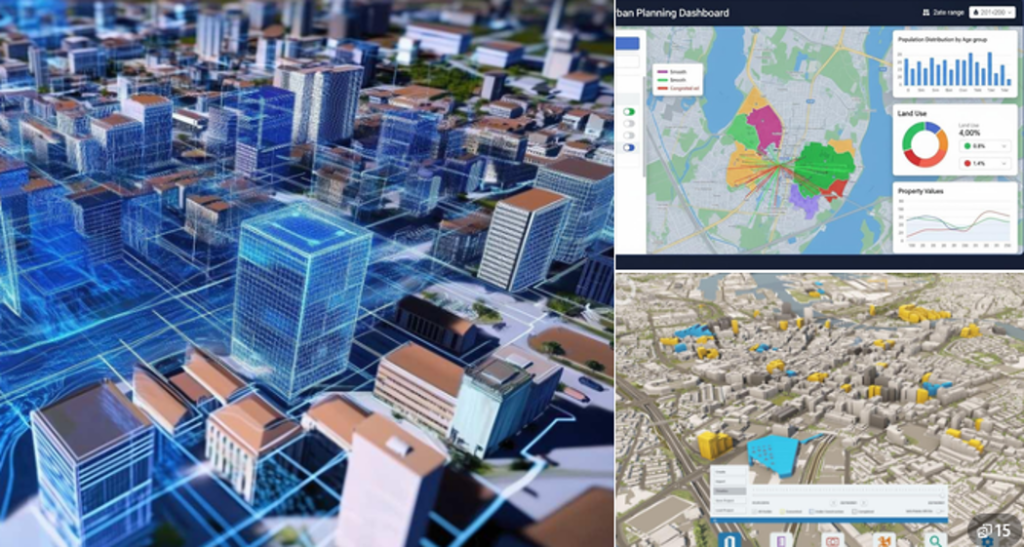
AI can bring these information sources together to create a more dynamic planning environment.
What will change?
| Traditional approach | AI-enabled approach |
| Periodic population projections | Continuously updated population estimates |
| Manual land-use analysis | AI-assisted satellite and GIS analysis |
| Historical traffic surveys | Predictive traffic modelling |
| Manual development assessment | AI-assisted application screening |
| Reactive infrastructure planning | Predictive infrastructure needs |
| Separate departmental databases | Integrated planning intelligence |
Example: Population growth and urban expansion
Imagine a developing country’s secondary city growing rapidly.
The planning department needs to determine:
- Where will new housing emerge?
- Where will schools and hospitals be needed?
- Which roads will become congested?
- Where should drainage infrastructure be expanded?
- Where should future commercial centres be located?
AI can analyse satellite imagery, census information, road networks, building permits and population trends to identify likely development patterns.
Instead of waiting five years for another comprehensive planning exercise, the department could update its understanding of urban growth much more frequently.
This could make master plans more responsive to actual development.
2. AI and the transformation of traffic departments
This is one of the areas where developing countries could experience some of the most immediate benefits.
Many developing cities experience:
- Severe congestion.
- Poorly coordinated traffic signals.
- Inadequate public transport.
- Road accidents.
- Unregulated roadside parking.
- Informal transport operations.
- Poor traffic data.
- Limited enforcement resources.
AI can help address these problems.
A. Intelligent traffic management
AI can analyse traffic flows using cameras, sensors, GPS information and mobile network data.
It can help traffic departments:
- Identify congestion hotspots.
- Adjust traffic signal timings.
- Predict congestion before it develops.
- Identify accident-prone locations.
- Monitor traffic violations.
- Coordinate traffic around major events.
- Identify where road improvements are needed.
For example, instead of operating traffic lights using fixed timings, an AI-assisted system could adjust signal timings according to actual traffic demand.
This could improve traffic flow without immediately requiring expensive road construction.
B. Predictive traffic planning
AI can help predict:
- Which intersections will experience congestion as population increases.
- Which roads will become overloaded following new housing developments.
- How new shopping centres will affect surrounding roads.
- How public transport routes should change as cities expand.
This moves traffic departments from managing congestion after it occurs to anticipating it before it becomes severe.
C. Intelligent public transport planning
AI can analyse passenger demand and help determine:
- Where bus routes are needed.
- How frequently buses should operate.
- Where bus terminals should be located.
- Which routes are underserved.
- How transport services should respond to changing demand.
This is particularly valuable in cities where informal minibuses, shared taxis and buses operate alongside formal public transport.
AI should help governments understand and improve these existing transport systems rather than assume that every city can immediately adopt expensive technology.
3. AI and town infrastructure planning
This is perhaps the most strategically important area for developing countries.
One of the biggest problems facing rapidly growing towns is that infrastructure development often follows population growth rather than anticipating it.
By the time a town experiences:
- Water shortages.
- Road congestion.
- Flooding.
- School overcrowding.
- Electricity shortages.
- Inadequate sanitation.
The infrastructure deficit may already be substantial.
AI offers an opportunity to move towards anticipatory infrastructure planning.
Examples of practical applications
| Infrastructure sector | Potential AI application |
| Roads | Identify road deterioration and prioritise maintenance |
| Drainage | Predict flood-prone areas and drainage requirements |
| Water | Predict demand, identify leaks and optimise distribution |
| Electricity | Forecast demand and identify infrastructure constraints |
| Housing | Monitor settlement expansion and estimate housing demand |
| Education | Forecast school demand based on population growth |
| Healthcare | Identify underserved areas and predict facility requirements |
| Waste management | Optimise collection routes and predict waste volumes |
The emergence of AI-powered town planning
Consider a town expected to grow from 150,000 to 300,000 people over the next 15 years.
A conventional planning department might prepare a master plan based on population projections and existing land-use surveys.
An AI-enabled planning department could develop several growth scenarios:
- Scenario 1: The town expands horizontally.
- Scenario 2: The town develops around existing transport corridors.
- Scenario 3: The town experiences concentrated commercial and industrial growth.
- Scenario 4: Unplanned settlements expand on the outskirts.
Each scenario could be assessed against infrastructure requirements, investment costs, environmental risks and economic opportunities.
The government could then determine which development pattern is most affordable and sustainable.
This is where AI becomes a strategic planning instrument rather than simply an administrative technology.
4. AI will change infrastructure investment and project management
Governments in developing countries frequently face a difficult problem: infrastructure needs exceed available financial resources.
AI can help governments decide where limited funds should be invested.
For example, a transport department might have 500 kilometres of roads requiring rehabilitation but funding for only 100 kilometres.
AI-supported analysis could help rank projects based on:
- Traffic volumes.
- Economic importance.
- Road condition.
- Accident history.
- Population served.
- Access to hospitals and schools.
- Maintenance costs.
- Expected economic benefits.
It could also help monitor infrastructure construction through satellite imagery, drone surveys, digital project records and progress reports.
This creates opportunities to identify construction delays, cost overruns and deviations from approved project specifications.
However, AI-generated project rankings should support professional and political decisions, not replace transparent public investment processes.
Get Interactive Online Monitoring
Check Live status of latest reports and findings